Finishing a draft is a genuine achievement — and roughly the halfway point. What comes next is the part most writers find harder: reading your own work as though somebody else wrote it. The trick is not to fix everything at once. Work in order of scale, from the largest problems down to the smallest, so you never spend a whole afternoon polishing a scene you decide to cut tomorrow. Here is the sequence that keeps a manuscript moving forward instead of circling.
Pass One: Structure and Plot
Before you touch a comma, ask whether the story works as a whole. A useful test is to write a one-line summary of every scene, in the form "X wants Y, but Z gets in the way." If a scene has no but, it probably has no conflict. If a scene ends with nothing changed — no new information, no decision, no shift in a relationship — it is furniture. Cut it, or merge it into the scene beside it.
Keep the summaries on a single sheet of paper and read them in order. The shape of the book becomes obvious fast, including the places where you have written the same scene twice without noticing.
- Does the opening establish who, where, and what is at risk within the first few pages?
- Does every subplot complicate or illuminate the main one, rather than simply running alongside it?
- Are there turning points at roughly the quarter, half and three-quarter marks — moments when the protagonist's plan has to change?
- Does the climax resolve the problem the book actually opened with?
- Does the ending arrive through your characters' choices, or through coincidence?
Pass Two: Character
Plot problems are usually character problems in disguise. When a middle section sags, the cause is almost always a protagonist who has stopped pursuing something specific. For each main character, you should be able to name what they want, what they are afraid of, and what they are lying to themselves about. All three need to be visible on the page, not just in your notes.
Then count agency. How often does your protagonist act, and how often do things happen to them? If the second number is higher, they will read as passive, however dramatic the events around them. Even a character trapped by circumstance can decide something on every page.
Give your antagonist a coherent reason for what they do, at least in their own mind; a villain who is simply cruel is a missed opportunity. Finally, cover the character names in a scene of dialogue and read it again. If you cannot tell who is speaking, the voices need separating.
Pass Three: Pacing
Read quickly, the way a reader would, and mark every point where you would put the book down. Those marks cluster in predictable places: a first chapter that does too much setup, a middle where the same argument repeats, a climax that arrives before it has been earned.
Two habits fix most pacing trouble. Start scenes as late as possible and end them as early as possible. Cutting the last two lines of a scene is nearly always an improvement, because those lines tend to explain the drama rather than deliver it. And vary your chapter lengths deliberately — short chapters build momentum, longer ones give the reader room to breathe. If every chapter is the same size, the book will feel flat even when the events are not.
Pass Four: Dialogue
Read it aloud, in your normal speaking voice. Anything you stumble over, a reader will stumble over too.
Good dialogue does at least two jobs at once: it reveals character, advances the plot, plants information, or shifts the balance of power between two people. If an exchange does only one, it is probably skippable. Cut greetings, logistics and throat-clearing — nobody needs to hear two characters agree to meet on Thursday unless the meeting matters.
Let people talk past one another. Real conversation is full of evasion, interruption and answers to questions that were never asked, and that friction is what makes a scene feel alive. Be sparing with adverbs in your speech tags: "I'm fine," she said angrily does the work twice. Use a beat instead: "I'm fine." She set the cup down harder than she meant to. Then trust said and asked to disappear.
Pass Five: Prose Style
Now you can look at sentences. Every writer has tics, and they are easiest to find if you know what to hunt for.
- Filter words: she saw, he felt, she noticed, he realised. Cut them and give the reader the thing itself.
- Repeated favourites: that word you have used eleven times in one chapter. Search for it.
- Weak verbs propped up by adverbs: walked slowly becomes shuffled; said quietly becomes murmured.
- Stage directions: nodding, smiling, sighing, turning. Keep a tenth of them.
- Cliché and mixed metaphor: if you have read the phrase before, so has everyone else.
Vary sentence length on purpose. Read a paragraph aloud and notice where your voice flattens into a monotone; that is usually a stretch of sentences built the same way. Check that your point of view holds, too. Slipping into another character's head for a single line costs the reader trust.
Pass Six: Proofreading
This is the last pass, never the first. Change the format before you start — read on paper, or in a different font on screen — because familiarity hides errors. Keep a style sheet listing names, places and house rules, and check these:
- Character and place names spelled consistently throughout
- Timeline: seasons, travel times, ages, days of the week
- Dialogue punctuation, including capitalisation after speech tags
- One spelling convention held throughout, British or American
- Hyphens, dashes, ellipses and numbers used the same way every time
- Chapter headings and scene breaks, present and in order
Spellcheck will catch typos but not the wrong word spelled correctly: their for there, rein for reign, poured for pored. These need a human eye, and a slow one.
The Order Matters More Than the Checklist
Work through these passes one at a time rather than trying to hold all of it in your head at once. Structure first, because a beautiful sentence in a scene that has to go is wasted effort. Then character and pacing together, since they tend to solve each other. Dialogue and prose style next. Proofreading last, always.
If you can, leave a week or two between finishing the draft and starting the first pass. Distance makes you a sharper reader of your own work, and it costs nothing. When you are too close to see something — a muddled motive, a joke that only lands for you — a trusted reader or writing group will catch it in ten minutes.
The checklist is a tool, not a rulebook. If a pass stops being useful, move on to the next. The only measure that matters is whether this draft is better than the last one.
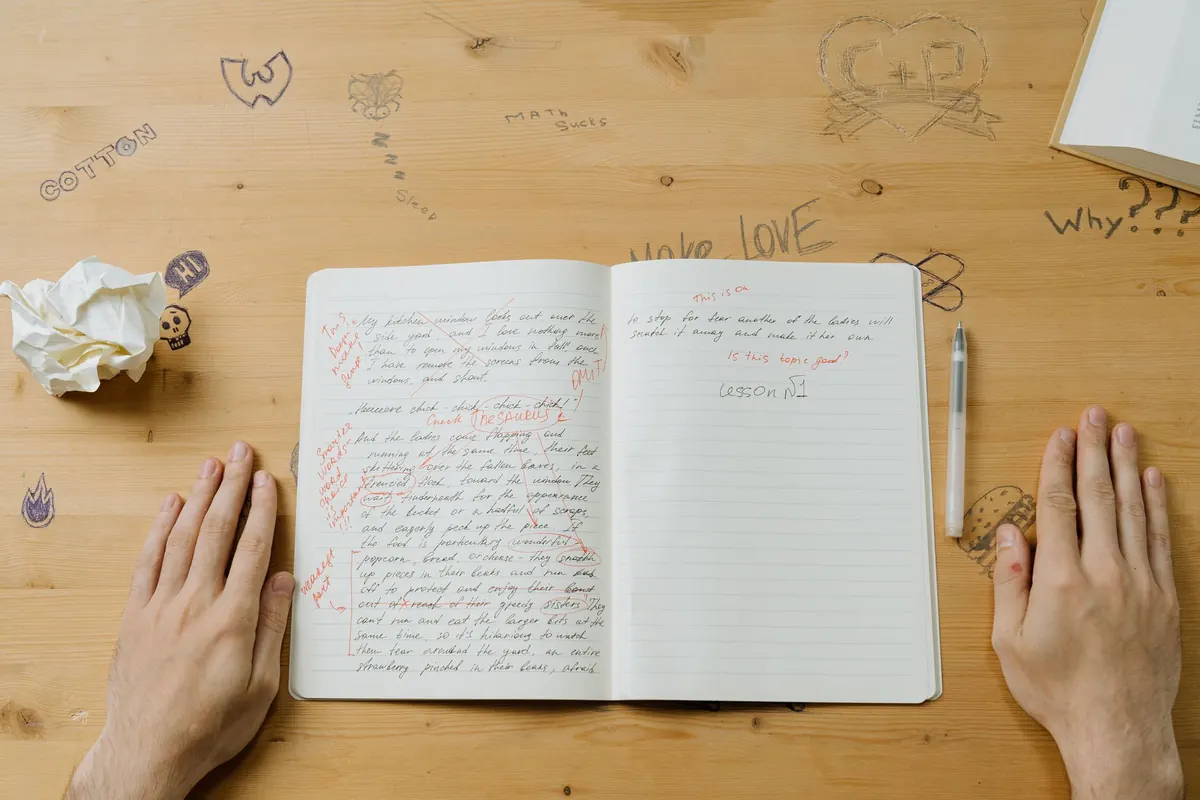
Photo: cottonbro studio / Pexels